
There’s an image crisis that’s taking over our era. Not that how you present yourself is a new thing. It’s part of our innate animal instinct to present well for reproductive purposes. Birds do it. Bees do it. Even ordinary social media accounts do it.
Presenting ourselves to achieve greater advantages in life started when the first humans discovered the power of selection. I choose you (and you, and you). Since germ warfare wasn’t as much of a medically known occurrence way back then, humans didn’t consider the multitude of ways that bacteria and viruses could exploit our systems for their benefit. So while we humans were choosing over and again, those germs had a party of their own. STD’s did their thing. People died from multiple-choice decisions.
When monogamy became the norm after some large scriptures were written by various prophets predicting the demise of mankind over bad behaviour, we were told we had to choose better. Choose wisely. In truth it was often parents that chose for their offspring, and more often than not for the advantage of the whole family (dowries, you know). Yet a poor selection of partner to swap germs, thoughts and ideas with could mean anything from a lifetime of dismay and disillusionment, to death by the hand of your spouse, or worse, your own (life sucks, and then you die).
When the internet became more widely used in the 90’s web bulletins and forums popped up for exclusive interest groups. We presented thoughts, ideas and desires using mostly the written word, accompanied at times by rudimentary computer graphics and low-resolution imagery. Many did so in secret. Why? Most likely due to fear of judgment, exile from ones community, abandonment from significant others, or once again – death.
With the opportunity to exchange ideas, thoughts, and feelings through a virtual platform behind a secret handshake at point of entry, suddenly a global thousand-years development of status quo rules based on dominant world religions, land territorialism and royal edicts, came under private scrutiny – one personal account after the next. The voice of the masses grew. A lot of different voices, sometimes with similar views, other times opposing. They kept growing louder as communications technology improved, one issue and one voice at a time.
A flourishing digital eco-system was not only good for extroverted voices, introverts suddenly felt safer to speak their truths aloud. In contrast to the centuries upon centuries it took to establish human systems of order, overnight everyone became judge, jury, victim and yes, convict. The crimes were small at first: little white lies, cheating (we’ve all heard some story by now about how internet activity influenced a marital shutdown), then they grew into organized sub-communities converging with the like-minded to take down organizations and create social disorder.
Where is this going? Covering a lot of millennia in as few words as possible, but remembering we are still animals (and supposedly the best version due to human intelligence), there are surely more reasons “image” has put us in crisis today, but here are my Top 3.
Top 3 reasons “image-seeking” has put us in crisis in the digital era:
- We care more about image than how our behaviour impacts the future.
We want to be seen. Our “image” appears to mean everything today. But at what cost? You disagree of course because you think about some things you said or did this week that covers you as being a very decent person. And I’m sure you are. I’m sure I am. As a marketer who protects brands for a living I’m fully aware that image goes well beyond the selfie, but the common denominator social media platforms of Facebook and Instagram were not designed for business use (despite how they’ve been modified for advertisers). They were designed with the individual in mind.
When my image is posted to social platforms I hope to gawd it’s my best angle. When I look over my shoulder and notice my daughter is watching, I fear she sees my perception of wanting to look my best more than she sees me simply being my best at something (which is not posing). “Is there anything wrong with this?” I wonder. She’s at the impressionable age of almost thirteen. Her own accounts inundate her with young people doing mundane things just to be seen.
No longer are kids influenced by their parents views based on what the news networks share with us. Today anyone can generate news of any caliber (“my dog and cat are so cute together” kind of news) and get millions of views. Anyone can view a public account (creepy), and as much as we want to believe that politicians have a handle on our national safety, no one yet knows how much data we are giving over to the other side. Who ever that really is.
We want to be seen as being creative, cool, fun, fashionable, sexy and interesting. But this at any cost? Image is everything in the digital landscape. How did this happen? Human nature. We seek acceptance, at our core, from our parents. That’s just how babies are hard-wired for survival when they enter the world. A lack of parental protection and basic sustenance at birth means sudden death. Parents don’t need babies to appear to be anything.
But children grow and the need for parental acceptance transforms into peer acceptance. Along with this, fears of falling victim to a group’s lack of acceptance, ergo abandonment from a group. Death by disassociation has young people at the disposal of their tribe to find ways to fit in. This isn’t new, but today it’s more often than not through a much larger tribe thanks to the expansiveness of social media.
- We fail to act.
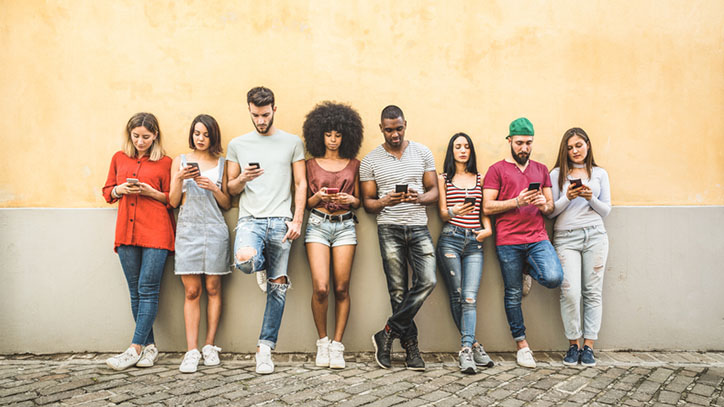
We post instead of act. We comment instead of act. Our spare time spent watching others “do life” on social media is time we take away from a plethora of other worthy activities and causes. There is no shortage of more books to be consumed, more charities to volunteer for, or less damaging ways to relax. We could be drawing a long bath with scented candles and blasting Queen Bey, instead we lock ourselves in the bathroom, grab our handhelds and scroll up with our thumbs as a means of breaking away. We could take a walk outside of school or office for a quick breather from our work, instead we step outside stand still and double-click to like post after post (for five minutes we’ll never remember), or coin a really crafty comment to post because we’re so witty and we want others to see that. (We’ll also forget that by tomorrow).
We post instead of act. We comment instead of act. We wait for the next worthy photo to post after a social or career event we’re attending. We plan visual patterns in advance of posting to our Instagram feeds to achieve the most branded look, or take time to consider what should be a long-term post vs. a short-term story with a limited life of 24 hours.
Time we’ll never get back. Memories which are fading faster because our brains are being rewired to be less effective. Time and again repeating the act of posting to social media, feeding the beast of image. Feeding artificial intelligence with more data to analyze how to become more human-like. Feeding our own need to be seen and heard. Feeding an unstoppable power, but feeling less emotion as time goes on. (I’m convinced the Mind Flayer in Stranger Things is a parody for the alt-reality that is social media.)
Feeling is what motivates us to act, love, create, and care about others. The longer we spend in a virtual state, the more disconnected we are becoming. Any human who has truly lived will tell you that a passionate feeling was what motivated them to greater feats. It takes little courage, effort or strength to live online. Because of our addiction to smartphones today, it takes tremendously more effort than ever to live offline (or “do life”).
Jean M. Twenge, PhD, author of “iGen: Why Today’s Super-Connected Kids Are Growing Up Less Rebellious, More Tolerant, Less Happy–and Completely Unprepared for Adulthood–and What That Means for the Rest of Us” has drawn detailed observations from the study of various data from four complex US-based data sets which have been asking the same questions of teens since the 1960’s. The book includes some interviews Twenge conducted herself with today’s teens to support her various theories, although some critics have slammed her for her conclusions (which ultimately blame iPhone use for how teens today will grow up drastically more self-preserved and afraid to try, than teens of the Millennial, Gen X and Baby Boomer generations).
As you can tell by the title, Twenge asserts that today’s teens are forecasted to become the most fearful adults to “do life” (her data claims to be representative of the diverse US population in terms of gender, race, location and socio-economic status). At least American teens, which I’m sure can somewhat apply to iGen/Gen Z teens in many first-world nations. Her findings are so depressing you may have to put it down halfway through reading it. I did, then picked up Ryan Holiday’s “Stillness is the key”. A book built on the combined philosophies of Stoicism and Buddhism that reflects largely upon how slowing down is the secret weapon to being more productive and effective in this digital life-on-speed.
- We are depressed more often.

We’ve become laser-focused on crafting the best possible image on social media, but at what cost to our health? Read on for two ways to begin the recovery process. It’s not just teens who are suffering from depression as a result of smartphone app overuse connecting us to engage by the minute with larger social groups. As members of working class society are encouraged by their employers to be more present on social media to advance their corporate brands and culture, we are caught up in the dichotomy of keeping up with appearances for the sake of work too.
For work or play we are entangled in a never-ending loop of double-clicking on social media platforms, broadcasting how we live/work/play, exploring others “do life”, noticing how our own lives compare and contrast, experiencing FOMO or worse, envy. Studies continue to prove that the more hours per day spent using social media, the more likely a person is to experience depression.
When we’re wrapped up in our own drama we can‘t be of service to others in a way that’s substantive or meaningful. While depression comes in a plethora of shades, the less clinical variety is manageable, even curable with the right tools, perspective, and use of time.
From personal experience having lived with depression off and on since my troubled childhood, I thought depression would always haunt me despite being a contributor to the workforce since university graduation. Dealing with depression drug-free, and grazing suicide in my early twenties, I can recommend with tremendous confidence these two things cured mine, and they can cure yours too: expressing gratefulness and going to the gym regularly.
Gratefulness flips your focus. When you’re busy focusing on why you’re so fortunate to have what you already have (it’s enough, I am enough), you feel good. When you feel good you smile. When you smile you send a message inwards that things are great. Don’t believe me? All the modern day gurus like Oprah, Deepak Chopra, and Jay Shetty have got it dialled. See what they have to say.
All I had to do was get a cancer diagnosis. Then, as if by magic, my depressive episodes dissipated into nothingness. Overnight I became deeply grateful for my life. I’m two years in remission and I find time at least once a week to say aloud what I’m grateful for, and the magic of inner peace kicks in. Don’t wait until a cancer-like experience happens to you. Using gratefulness as a means of starting each morning instead of picking up your smartphone to check your image status will have a life-altering impact on your mental well-being.
I also picked up my gym game. Before cancer I lifted weights about 3 times weekly. After cancer treatments I found a whole new level of bodybuilding and joined WNBF (World Natural Bodybuilding Federation) to compete. And since research has shown that lifting weights helps lift depression, cardiovascular activities reduce the effects of anxiety, and any type of movement improves mental health, why are there not swarms of people in every gym in town, all the time instead of masses of people living virtually?
We have become laser-focused on crafting the best possible self-image thanks to the adoption of social media so involuntarily into our day-to-day activities, but at what cost to our health? And at what cost to humanity?
It’s painfully obvious the next generation will not thrive unless we act now. Unless we change first. Maybe it’s time we started serving others (in person) before serving up a new post. Maybe it’s time we started talking about scheduling in time to check in on social media when we have time for it, instead of allowing social media notifications to check in on us (“Are you there? You haven’t posted in a while.”).
Maybe it’s time to be grateful for what we have instead of desiring more. And maybe we can hit the gym more often this week to meditate through some reps while getting our dopamine and serotonin the good old-fashioned way.
By Penny Greening

